

Some Or All Files Unprotected Unraid
T he word "cache" comes from the French, cacher, meaning "to hide". The concept turns up all through information technology in a number of unlike contexts and physical implementations. Merely these all share the idea that something—commonly a set of binary data—is being kept somewhere in a "hidden pocket".
Typically, this will exist a bunch of data on its fashion to somewhere else. The cache pretends to the sending system that the information accept arrived at their destination and will at some signal relay them on there. In this style, a advice channel that may be deadening tin be represented to the sending system as being speedy.
As we've discussed, all information newly written to the UnRAID array has to have its parity calculated and the result written simultaneously to the parity drive. The delay while this calculation and double drive write happen can make the UnRAID system look dull to accept data. An intervening cache drive, needing none of the parity calculations, tin can speed upwardly the data transfer. And speed it up significantly if information technology is a solid state drive (SSD).
I WAS GOING TO First THIS CHAPTER by telling you that the SSD cache would be "adding the final touch" to this UnRAID NAS. That'southward quite the incorrect way of putting it.
Yes, this affiliate is the terminal planned for this series. Simply 1 thing I've come to realise during this adventure is that in that location'southward no "terminal touch" to an UnRAID server. Unlike, for example, Manek's TrueNAS arrangement, which yous design, build and so that'due south information technology—until you demand to expand it, a process that volition almost certainly need another design and build. An UnRAID system is elastic, whether you want to expand it, contract it, run other stuff within it or around it or even movement it (equally we've already seen) from i chunk of hardware to another.
I'll get onto the addition of the cache bulldoze in a moment. (The truth is, this process is so simple there'southward not much to write about). Simply while we're philosophising about UnRAID, let me list here some thoughts that accept struck me well-nigh how it might typically develop for y'all if you follow this path.
Of class, if you have a spare PC ready to run UnRAID, it would make perfect sense to start out by investing in a single large hard drive. Five hundred quid would give you a reliable 16TB to offset with and an UnRAID basic licence would add another £45—a really useful startup NAS with endless room for expansion and experiment at a price per terabyte information technology would exist difficult to friction match elsewhere.
I've said that what originally attracted Tested Technology to the UnRAID proposition was beingness able to start with whatever drives you have to manus: you lot can shuck them from USB storage devices, you lot tin rescue them from defunct desktops and laptops, release them from the prison house of a more than stringent NAS. Then you pile them into a pensioned-off PC, run them through the gruelling preclear process and, if they laissez passer, assign them to the array. And now you take a powerful, truly flexible, information storage device.
You lot may exist happy with this. The odd hard drive will fail now and again and you will exist able to bandy it out for a new ane without loss of information. If you accept this opportunity to invest in one of the newer larger drives you'll be able to install that one every bit the replacement parity bulldoze and reassign the previous parity drive to duty as a data bulldoze in the assortment. As drives go larger your array volition exist able to shrink in bulldoze numbers while increasing in chapters. And all this will be happening dynamically—this is what I'grand calling the "organic quality" of UnRAID you won't find elsewhere* .
*Synology has a proprietary technology called Synology Hybrid RAID (SHR) which allows dissimilar sized drives and more than flexible expansion than regular RAID. It's something Tested Technology is hoping to exist able to report on. But whatsoever proprietary RAID using data striping will inevitably complicate data recovery later failure.
Less is more.
Why would you want fewer drives?
Firstly, equally we've seen, the price hot-spot of hard drives tends to shift to the newer, larger drives, though perhaps non the very newest at their time of arrival on the market. And as the technology develops, the newer drives tend to be more reliable.
Larger drives hateful you will need fewer of them for the same capacity. You lot'll save on ability consumption and you'll be reducing the points of failure.
You might then reasonably ask me "Why 8 bays, then, Bidmead?" Our Plan B started with UnRAID running very nicely on a mere 4-bay device. Why expand this to eight?
* This will depend on how far y'all trust the SSD. You'll meet below that mirroring the SSD isn't something I'one thousand contemplating.
The commencement answer is that the additional drive bays provide room to improve resilience. An extra cache drive mirroring the first to ensure that transient information won't get lost*. And a second parity drive, non mirroring the offset just using a unlike parity algorithm, would allow for two drive failures without data loss.
There's some other answer for those less concerned most information loss. While many UnRAID builds are based, as we originally intended, around an one-time Intel PC, those first days with the UnRAID-converted QNAP TS-451 convinced me that hot-swappable bulldoze bays are a great thing to have, especially if you're experimenting. And if you lot have hot-swappable bays, they're a very useful identify to keep drives, whether they're part of the array or not.
The UnRAID community's UnAssigned Devices app allows you to use these drives outside the array. And so, autonomously from the two data drives, the parity drive and the cache that currently make upwardly the official UnRAID array, the extra four bays requite Tested Technology the pick of running a more or less autonomous JBOD server from the aforementioned device.
The minor downside of sharing unassigned devices is that you can only share them as unabridged drives or whole partitions and the shares all accept to be public—that is to say, non password protected. This is a limitation in the current vi.eight.3 version of UnRAID. Only I understand a future version may allow more flexibility in how unassigned devices are presented to the LAN.
That Hidden Pocket
Nosotros've seen how calculation a regular drive to the array is a matter of associating information technology with an UnRAID logical drive slot. Calculation a cache drive follows the aforementioned process simply using a special drive slot called Cache. There's also a second Cache slot in case you feel you need to mirror the enshroud.
If the cache bulldoze SSD is large enough, it's besides common practise to use it as the drive to keep dockers and virtual machines.
This is something yous might want to do if yous're using some of the new, much cheaper no-name SSDs. Your UnRAID cache arrangement is considered to be office of the assortment but won't participate in the parity checking. Its $.25 aren't included in the parity calculations, pregnant that it makes no contribution to protecting the chief data drives and in plow is unprotected itself.
 The philosophy seems to be that cache drives aren't inherently trustworthy and the data they handle will mostly be relatively low volume and transient. According to a schedule you set, an internal UnRAID function called The Mover (a name that sounds like a 1970s TV serial you may have missed) rises from slumber (typically overnight merely at whatever fourth dimension of your choosing) and shifts the data intended for particular shares into the respective parity-protected storage.
This is the second key indicate nigh the cache. It's operating on a per share basis, non per drive or universally beyond the whole array. And although an UnRAID share tin can be associated with a particular drive, like the normal PC arrangement, conceptually it floats independently across whatsoever or all of the drives in the array as yous determine when setting up that share.
Whereas a classic RAID arrangement will distribute any and all information across the drives in accordance with its ain pre-ordained internal schema, with UnRAID, you get to decide whether a share is going to reside on Drive 1 or Drive 2 or Bulldoze due north or all of them or only several of them. And also how or whether directories are to exist divide betwixt the drives. However you design this, no individual files volition always be carve up across multiple drives. Good news if you e'er need to recover data from a drive disaster.
As system admin, you have choices nearly how or whether each share uses the cache. Across the LAN, the user will always see those data every bit being inside the share. Simply under the covers, they might be on the cache or the assortment. The per share options are:
-
- No: none of these information will touch the enshroud
- Yes: all data will be written to the cache and afterwards moved to the array
- Simply: all data volition be written to the cache and will stay at that place
- Prefer: information will remain on the cache and whatever array data for that share will be transferred there
The choices in blue remain untouched by the Mover. The red choices apply the Mover.
Installing the Cache Drive
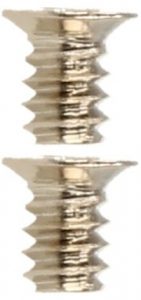
* Two screws are plenty for both iii.5″ and 2.5″ drives. Just equally well—these QNAP caddy screws turn out to be expensive and hard to detect. Although the thread is common enough, the heads need to be completely countersunk and flat to avoid snagging on the bay rails. I was a screw short and had to grind one down to fit.
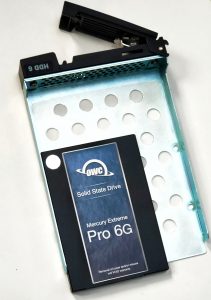
No large deal, as I've said. The QNAP caddies take screwhole positions for both 3.5″ and two.5″ drives*. Once installed in the caddy, the two.5″ cache SSD bulldoze slides in and locks in position like whatever other drive.
This particular cache SSD, though, is rather special and we came upon it through sheer good luck and timing.
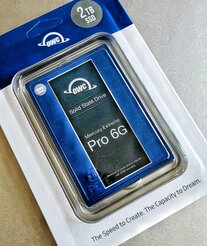
Tested Applied science was discussing, via email, the product range that the Californian visitor OWC offers, mostly expansions and upgrades for Apple users. OWC stands for "Other World Computing" and is built around some interesting ethics that nosotros thought were worth further investigation. Among their product range is a series of SSDs and nosotros asked if they'd fancy contributing one to this UnRAID series.
They came through in spades with a Mercury Pro Farthermost 6G, a pinnacle of the range endurance SSD that comes with 24/7 online support and a five-yr warranty to lucifer the Seagate IronWolfs and the Exos.
I've mentioned that if you don't trust SSDs you lot can mirror a pair of them as an extra precaution. A shut culling would be to install an SSD that'south much bigger than any chapters you lot might envisage needing. SSDs wear out and they wear out faster as they approach their capacity. Having plenty of spare wriggle room allows the SSD's built-in controller to distribute the wear more easily. Manufacturers volition typically allocate some vii% of actress space, not cited in the specs and not directly attainable to the user, for this purpose. But nothing beats having very much more infinite than you're going to be using.
 A 3rd selection might be to ensure your SSD uses Raise. This is a technology that was adult by the controller pattern company, Sandforce, nearly a decade ago. The acronym stands for "Redundant Array of Independent Silicon Elements" and borrows its ideas from RAID.
RAISE controllers work very similarly to RAID 5. An SSD is made up of a number of split retention components (chosen "dies") and RAISE treats these in much the same fashion as devices in RAID five array, spreading the data beyond multiple dies along with plenty parity information to enable recovery from a failure in a sector, page or entire cake.
Although SSDs are much less vulnerable to physical mishandling (unlike hard drives, they're virtually unshockable), the writing and reading of individual $.25 takes a much heavier toll than on rotating mechanical memory. In fact, individual bits are never written to SSDs—to change just a unmarried flake, an entire cake has to be read into temporary memory, the bit changed there, and and then the whole cake written back to the SSD.
SandForce controllers that implement RAISE are widely used in SSDs across the industry. Simply consumer-course SSDs tend to leave RAISE switched off in order to offer a larger capacity for the same corporeality of raw storage.
Drives employing RAISE are said to accept a quadrillion fewer uncorrectable chip errors than UnRAISEd drives. That'due south in America, where a quadrillion is a mere 1,000,000,000,000,000. The British quadrillion is considerably more expensive at 1,000,000,000,000,000,000,000,000, merely that seems to have gone the manner of the guinea*.
(* I pound sterling and one shilling (£i.05), for younger readers. The guinea money was no longer minted after 1816. Merely up until the Second World State of war, professional fees and luxury items were still being priced in guineas.)
This OWC SSD seems to exist the perfect solution to a single SSD UnRAID setup. It has enormous capacity—2TB—and uses RAISE, so we're very grateful to OWC for the donation. Of class, you lot tin always implement UnRAID cache with a smaller, cheaper SSD (and they're getting cheaper fast). Only in that case, nosotros'd definitely recommend doubling up with a pair of mirrored enshroud drives.
Speed Trials
In affiliate 1 nosotros looked at the raw read speed of a rotating drive on the array. Now that nosotros've added a cache we can examine how this improves the speed of writing to the array.
That last sentence needs a careful think. Y'all'll recall that any writes to the array using the cache won't really be using the array at all—it's simply that the data are going to end up on the assortment once the Mover has done his thing.
Nigh of the writing to the UnRAID NAS will be from customer devices across the LAN. But I idea it would exist a useful start to check the upshot of the cache on the data transfer speed from one drive on the NAS to another.
This sort of inter-drive transfer isn't something you lot become to do on a regular NAS but is bread-and-butter to UnRAID. At that place will exist files on unassigned devices that you want to transfer to the array; in that location will be directories carve up between different drives because yous asked UnRAID to practice this, but which you now want consolidated onto a single bulldoze. You'll also want to check across drives for duplicate files and sync directories that are meant to be mirrors of one some other.
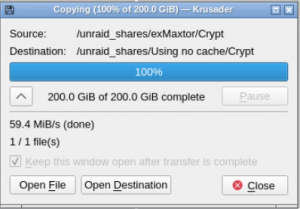
You do all this kind of piece of work using standard Linux utilities like Krusader (the file manager) and DupeGuru (for deduping). Whereas files and directories on a conventional RAID NAS exist in a "black box" simply visible through the WebUI, with UnRAID you can open the side of the fish tank and peer right in.
By fashion of case, here's Krusader transferring that 200GB VeraCrypt file from one array drive beyond to another, without using the cache.
We tin can repeat the exercise using the cache. Although the target directories here are called "Using no cache" and "Using cache", in fact they're the same logical UnRAID directory. In other words, I've created 2 shares that state their contents in the same place, 1 of which, though, diverts incoming traffic through the cache drive.
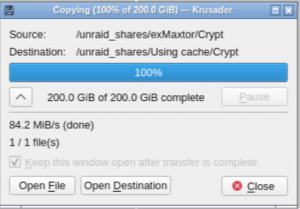 Yous'll see that in this instance the cache provides a significant speed heave of around 40%.
I was getting like results for transfers from unassigned devices to the assortment. That'south the speed the fish are swimming within the tank. But, as I say, the nigh generally useful measurement would exist for information transfer speed across the LAN.
This is going to be a looser metric every bit there are more than factors playing into the transfer. The QNAP TS-853 Pro has four Ethernet ports and these can be bonded to produce a theoretical transfer speed of 4Gb/sec. This sounds fast.
Merely, hold on, these are bits nosotros're talking virtually. Yous can rule-of-thumb divide this figure by 10 to go bytes(viii bits to a byte and two more than bits to business relationship for control and check protocols). So those four bonded Ethernet links are at the very best but delivering around 400MB/s. This is approaching SATA III speeds simply equally we've seen, actual deejay transfers are well below that anyhow. So using the total complement of Ethernet ports wouldn't provide a clogging.
Only nosotros currently accept the TS-853 Pro wired into the network with simply a single Ethernet cable. That's 100MB/s, tops. Information technology's not hard to meet that unless this 1Gb/sec connexion is performing completely transparently it might have some touch on on data transfer speeds.
Another factor would be the speed at which the data are pulled off the source device. In this test, we're using Tested Engineering'southward 4-bay TS-451+. And in this instance, instead of pulling in a single big file, the UnRAID device will be soliciting a large number of smaller files. These requests volition exist consuming additional transfer bandwidth. And the TS-451+ will accept to hunt out the location of each individual file, some other potential drag on the transfer.
We can use Krusader running inside the UnRAID NAS again for this exam equally information technology knows how to adhere shares from beyond the LAN.
Hither's how it pans out.
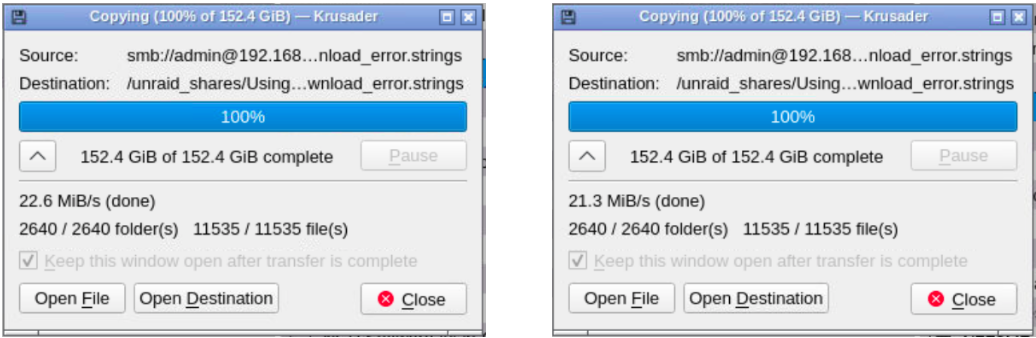
This surprised me. The figure of 21.iii MB/s on the correct is using the cache. Statistically and practically, the difference is too close to phone call.
But something else was going on with the UnRAID system at the same time. It's scheduled to run a parity check every month. This has all the drives churning pretty solidly for nigh a solar day and a half. Although I don't encounter any degradation of services like movie streaming, the WebUI Dashboard shows me that the processor is working very difficult. Would this exist responsible for the unimpressive cache issue?
In fact, no. Tests with and without the parity check running, whether transferring this directory of multiple files or the single 200GB VeraCrypt file, indicated that, for the transfer of files over our 1GB/sec LAN, the enshroud has no appreciable effect on write speed.
One interpretation might be that Tested Engineering needs a faster LAN. But looked at the other style, you might say that these fast-spinning Seagate enterprise drives are a good match for a NAS wired into a 1GB/sec LAN, and setting up a cache is redundant. With slower NAS drives the enshroud might make a difference.
That's not to say that our internal SSD has no purpose. We've seen how information technology speeds data transfers inside the NAS, which could be specially useful for drive-intensive operations like deduping. An SSD is also the ideal location for docker and VM images.
The OWG Pro 6G stays. Information technology'south merely that we're probably non going to be setting our UnRAID shares to "Use cache pool, Yes".
Shutdown

That's as a far as I want to have this adventure for the moment. UnRAID is a huge suggestion and we've only been able to offer you a taste of information technology in these five chapters. I hope that taste has given you an appetite to investigate farther.
If and so, there's plenty of detailed data on the Web. You might want to start with YouTube and I can't recollect of a better launchpad than SpaceInvader I's channel, perhaps kick off with this one. Other videos on his channel can guide you into the installation and management of dockers and VMs, which we've inappreciably touched on hither. The UnRAID Forum is another valuable source of help.
Oh, but wait… There's more. Prasanna, the eBay guy who put u.s.a. on to the QNAP solution has offered a supplement most his own new build.
Chris Bidmead: 02-Dec-20
Source: https://www.testedtechnology.co.uk/the-unraid-story-prelude-ch-0-2/the-unraid-story-chapter-4-time-to-cache-in/
0 Response to "Some Or All Files Unprotected Unraid"
Post a Comment